


 Cart
Cart
 sales@molnova.com



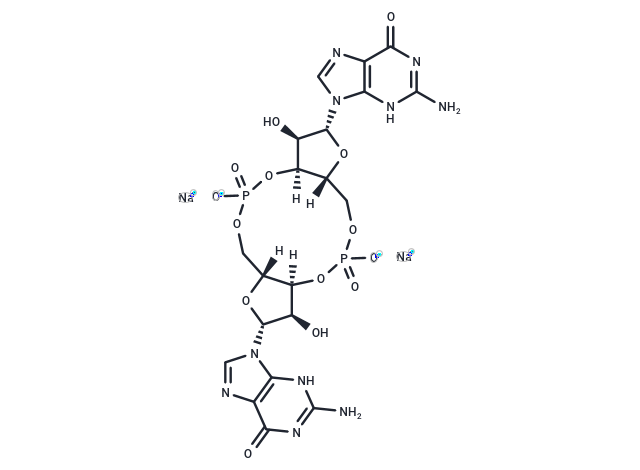
Cyclic-di-GMP disodium
CAS No. 2222132-40-1
Cyclic-di-GMP disodium( —— )
Catalog No. M34900 CAS No. 2222132-40-1
Cyclic-di-GMP disodium (5GP-5GP disodium) is a STING agonist and a second messenger in bacteria.
Purity : >98% (HPLC)
 COA
Datasheet
HNMR
HPLC
MSDS
Handing Instructions
COA
Datasheet
HNMR
HPLC
MSDS
Handing Instructions
| Size | Price / USD | Stock | Quantity |
| 2MG | 211 | Get Quote |


|
| 5MG | 353 | Get Quote |
|
| 10MG | 487 | Get Quote |
|
| 500MG | Get Quote | Get Quote |
|
| 1G | Get Quote | Get Quote |
|
Biological Information
-
Product NameCyclic-di-GMP disodium
-
NoteResearch use only, not for human use.
-
Brief DescriptionCyclic-di-GMP disodium (5GP-5GP disodium) is a STING agonist and a second messenger in bacteria.
-
DescriptionCyclic-di-GMP disodium is a STING agonist and a bacterial second messenger that coordinates different aspects of bacterial growth and behavior, including motility, virulence, biofilm formation, and cell cycle progression. Cyclic-di-GMP disodium has anti-cancer cell proliferation activity and also induces elevated CD4 receptor expression and cell cycle arrest. Cyclic-di-GMP disodium can be used in cancer research.
-
In VitroCyclic-di-GMP disodium (0.5-50 μM; 5 days) inhibits proliferation of human colon cancer cells.Cyclic-di-GMP disodium (0.5-50 μM; 5 days) specifically elevates CD4 expression in Jurkat cells.Cyclic-di-GMP disodium (0.5-50 μM; 5 days) induces cell cycle arrest at the S-phase in Jurkat cells.Cell Proliferation Assay Cell Line:H508 cells oncentration:0.5-50 μM Incubation Time:5 days Result:Reduced basal H508 cell proliferation by approx 15%, even inhibited acetylcholine- and EGF-induced cell proliferation.Cell Viability Assay Cell Line:Jurkat cells oncentration:50 μM Incubation Time:24 h Result:Specifically induced of CD4 (no effect on the expression of CD8), with a 6.3-fold upregulation over control and in a dose-dependent manner.Cell Cycle Analysis Cell Line:Jurkat cells Concentration:50 μM Incubation Time:24 h Result:Increased the percentage of cells in S-phase by 79%, with almost complete disappearance of G2/M-phase cells which decreased by 93%.
-
In VivoCyclic-di-GMP disodium (100 μg/per; i.v.; two sequential vaccinations 9 days apart) enhances TriVax-induced immune responses to melanoma in mice and further increased the anti-tumor effects of TriVax.Animal Model:C57BL/6 (B6) mice (8- to 10-week-old).Dosage:100 μg/perAdministration:Intravenous injection; two sequential vaccinations 9 days apart; combine with TriVax.Result:Significantly higher numbers of antigen-specific CD8 T cells when combined with TriVax. (TriVax consisted of a mixture of 120 μg Pam-hgp100, 100 μg hgp100 or 100 μg Ova, 50 or 25 μg anti-CD40 antibody, and 25 μg Poly-IC).Enhanced the anti-tumor activity of TriVax.
-
Synonyms——
-
PathwayProteasome/Ubiquitin
-
TargetEndogenous Metabolite
-
RecptorEndogenous Metabolite | STING
-
Research Area——
-
Indication——
Chemical Information
-
CAS Number2222132-40-1
-
Formula Weight734.38
-
Molecular FormulaC20H22N10Na2O14P2
-
Purity>98% (HPLC)
-
SolubilityIn Vitro:?H2O : 160 mg/mL (217.87 mM; Ultrasonic)
-
SMILESO=C1C2=C(NC(N)=N1)N([C@H]3[C@@H]([C@@]4([H])[C@](COP([O-])(O[C@]5([H])[C@@](O[C@@H](N6C7=C(C(N=C(N7)N)=O)N=C6)[C@@H]5O)([H])COP([O-])(O4)=O)=O)([H])O3)O)C=N2.[Na+].[Na+]
-
Chemical Name——
Shipping & Storage Information
-
Storage(-20℃)
-
ShippingWith Ice Pack
-
Stability≥ 2 years
Reference
1. Karaolis DK, et al. 3',5'-Cyclic diguanylic acid (c-di-GMP) inhibits basal and growth factor-stimulated human colon cancer cell proliferation. Biochem Biophys Res Commun. 2005 Apr 1;329(1):40-5. ?
molnova catalog



related products
-
5'-Guanylic acid
5'-Guanylic acid is involved in several metabolic disorders, including AICA-ribosiduria pathway, ?adenosine deaminase deficiency,adenine phosphoribosyltransferase deficiency (aprt), and the 2-hydroxyglutric aciduria pathway.
-
5,6-Dihydroxyindole
5,6-Dihydroxyindole (Dopamine lutine) is a melanin precursor and has a broad-spectrum antibacterial, antiviral, antifungal, antiparasitic activity.
-
1-Myristoyl-2-stearo...
1-Myristoyl-2-stearoyl-sn-glycero-3-phosphocholine is an endogenous metabolite.
